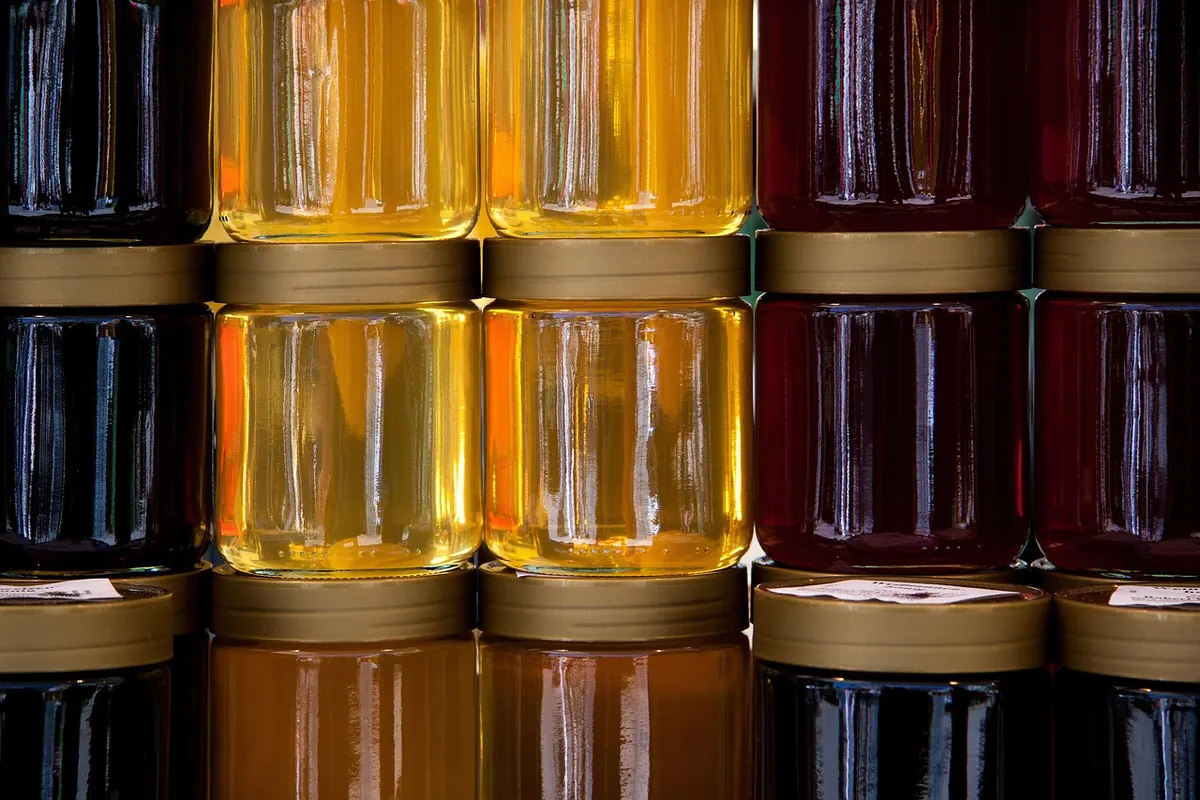
Hand a jar of honey across a stall and someone will eventually bring it back. It has gone sugary, they will say, or they will poke at the solid contents and ask what you did wrong. Usually nothing at all. Honey crystallises because that is what a supersaturated sugar solution does when it sits still, and it will do it whether the jar is on a market table, a supermarket shelf or in your own cupboard.
Crystallisation is a change of texture, not a fault. It is not spoilage, and it is not evidence that honey has been stretched with sugar syrup. What it does tell you is that you are eating real honey — and if you sell the stuff, that is the line to put on the label before anyone has to ask.
Why honey crystallises
Honey is roughly 80 per cent sugar and only about 17 per cent water. That is far more sugar than water could normally hold at room temperature, which makes honey a supersaturated solution — a liquid balanced on a knife edge. Leave it alone and it will stay liquid more or less indefinitely. Give it a reason to tip, and the sugar starts coming back out as solid crystals.
The reason is usually tiny. A speck of pollen. A dust particle. A fragment of wax. A cool night on a shelf. Those specks act as nuclei — seeds around which crystals can form — and once a few crystals exist, they grow.
Two sugars do most of the work. Glucose crystallises readily; it is the one that goes solid. Fructose stays syrupy and actively resists the process. So the glucose-to-fructose ratio of a particular honey largely decides what happens next. A honey high in glucose can set in a fortnight. A honey high in fructose can stay pourable for years.
Temperature matters too, and it behaves in a way that surprises people. Crystallisation is fastest at around 13–14°C — a cool larder, a garage, an unheated porch. Colder than that and the crystals slow down; put honey in the fridge and it may take far longer to set, or set unevenly. Warmer than about 25°C and it slows again. A jar kept in a warm kitchen may stay runny for ages and then set the moment it is moved somewhere cooler.
Honey crystallising is not honey going wrong. It is honey behaving like honey.
Raw, runny and set: what the labels really mean
Here is the confusion worth clearing up. Raw is not a texture. Runny and set are. They describe different things, and a honey can be any combination of them.
Raw honey
Raw means minimally processed: not heated above hive temperature, not finely filtered. It still carries pollen, traces of propolis, flecks of wax and its natural yeasts. Raw honey often crystallises faster than processed honey, because all those particles are ready-made nuclei and the glucose crystals have somewhere to start. But raw honey can be runny or set. Raw acacia honey may stay liquid for years; raw oilseed rape honey may be solid within a fortnight.
Runny honey
Runny honey has usually been gently warmed and finely strained so that existing crystals are dissolved or filtered out. The result is pourable and reassuring on a shelf. Some honeys are naturally runny because their fructose content is high enough that they barely need help.
Set honey
Set honey is deliberately crystallised — either left to set naturally or made as soft set (also called creamed honey) by stirring fine seed crystals into liquid honey so that it sets with thousands of tiny crystals instead of a few large ones. Good set honey is smooth, pale and spreadable. Gritty set honey means the crystals grew large, which usually happens when honey sets slowly and undisturbed.
And a fourth: heather honey
Heather honey is thixotropic — a stiff gel that resists a spoon until you stir it, at which point it flows. It is not crystallisation in the usual sense, but it confuses people in exactly the same way, so it is worth knowing about.
What your honey's habits tell you about it
Once you know the glucose-fructose pattern, honey stops being a mystery. These are tendencies rather than rules — the flowers, the weather and the season all shift the ratio — but they are reliable enough to be useful.
- Oilseed rape and canola — very high glucose. Sets in days to weeks, and sets hard.
- Clover — medium. Typically sets within a few months.
- Sunflower — sets readily, often with a coarse grain.
- Linden (lime) — high glucose, sets fast, can be grainy.
- Acacia, tupelo, sage, borage — high fructose. Stays liquid for years.
- Manuka — variable, but usually slow to set, and often sets smooth and creamy.
- Heather — thixotropic gel rather than a true crystallising honey.
A jar can also set from the bottom up, which alarms people. Crystals are denser than the liquid around them, so they sink, and the base of the jar is usually the coolest part. A honey that is clear on top and solid underneath is behaving perfectly normally.
Telling crystallisation from spoilage
This is the bit worth pinning to the stall. Crystallised honey is safe to eat. Fermented honey is a genuinely different thing, and it looks different.
- Crystallised honey: solid or semi-solid, pale or opaque, smooth or grainy, with no bubbles and no pressure in the jar. It smells of honey, tastes sweet, and may carry a faint buttery or fudgy note.
- Fermenting honey: fizzy, foaming, visibly bubbling, sometimes hissing when you open it, with a bulging lid. It smells of alcohol, yeast or vinegar and tastes sharp or sour.
Fermentation happens when honey has too much water in it — generally above 18–20 per cent — which allows wild yeasts to work. It occurs in damp seasons, with honey taken from uncapped frames, or with jars left open in a humid kitchen. That is spoilage. Crystallisation is not.
How to liquefy crystallised honey without ruining it
- Loosen the lid to a quarter turn so steam can escape.
- Stand the jar in a pan of warm water — around 40°C, hand-hot rather than scalding.
- Keep the water level below the jar's shoulder so nothing seeps in.
- Wait. Twenty minutes for a small jar, longer for a large one, stirring occasionally with a clean spoon.
- Top up with warm water as the pan cools. Repeat until the crystals are gone.
Avoid boiling water, direct heat, the oven and microwaving honey in its jar. Above roughly 45°C you begin losing the volatile aromatic compounds that make honey taste of anything in particular, along with enzymes and the structure of the pollen. Supermarket honey has usually been heat-treated already, so there is little left to lose. A raw, single-origin honey is worth treating gently.
One more thing: liquefying honey does not reset it. Once you have melted the crystals, the nuclei are still there, and the honey will usually set again — often faster, and sometimes coarser than before. That is normal, not a sign you did it wrong.
Why crystallised honey is worth eating, not fixing
- It spreads like butter and will not run off toast, crumpets or a warm scone.
- It stays put in a sandwich instead of soaking through the bread.
- It dissolves perfectly well in tea or porridge; stir a little longer.
- It bakes identically. Weigh it rather than measuring by volume, because it is stubborn about leaving the spoon.
- It clings better in marinades, glazes and dressings.
- Stirred through yoghurt it gives a pleasant, slightly grainy texture, like honeycomb.
For anyone selling honey
Get ahead of it. A single line on the label — "Raw and unfiltered, so it may crystallise. This is normal." — is cheaper than a conversation six weeks later, and it turns a complaint into a selling point. Keep a small pan of warm water behind the stall if you want to demonstrate. If you are jarring set honey deliberately, aim for fine crystals: seed it with a smooth creamed honey, stir twice a day for the first few days, and keep it cool. If you are selling runny honey, be honest that it may eventually set, because most raw honey will.
And keep a jar of the crystallised stuff back for yourself. It is the version you can actually get out of the jar without a knife.
Quick answers
Does crystallisation mean my honey is adulterated? Almost always the opposite. Sugar syrup blends tend to stay runny, because their sugar ratios are engineered that way and they contain none of the pollen and particles that seed real crystals.
Is crystallised honey safe? Yes, entirely. It is the same honey in a different physical state.
Will it go off? Not by crystallising. Keep it sealed, use a dry spoon, store it at room temperature, and it will outlast most things in the cupboard. Fermentation is the only real risk, and it needs excess moisture to start.
Should I throw it away? No. Warm it, eat it set, or bake with it. Either way, you have bought something honest.
Photo: stux / Pixabay